Little Unicorns, Vector Clip Arts and Patterns: A Practical Evaluation for Designers and Creators
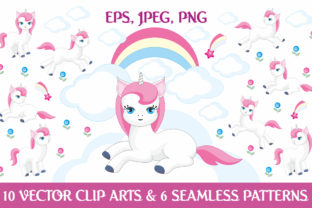
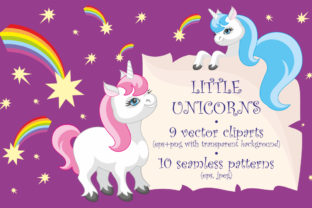
Little Unicorns, Vector Clip Arts and Patterns is a curated digital design resource designed for creators who need playful, high-quality vector assets without sacrificing technical flexibility. It’s not a broad illustration library or a subscription-based platform—it’s a focused, downloadable package containing 9 individual vector clip art files and 10 seamless pattern swatches, delivered in multiple formats (EPS, JPG, PNG) for immediate use across both print and digital workflows.
What Sets This Package Apart
Unlike generically themed clip art collections, Little Unicorns, Vector Clip Arts and Patterns balances whimsy with professional-grade production. Each of the 9 clip art illustrations is built as a layered, editable vector (EPS), meaning designers can adjust colors, isolate elements, scale infinitely, or adapt components for branding—no pixelation, no quality loss. The 10 patterns are truly seamless: tested at various tile sizes and orientations, they repeat cleanly in design software like Adobe Illustrator or Affinity Designer without visible seams or alignment artifacts.
The file structure reflects practical usage. Nineteen EPS files include both full compositions and isolated elements (e.g., a unicorn head, a cloud, a star cluster), allowing for modular reuse. Ten JPGs provide quick previews or web-ready references, while nine PNGs offer transparent-background versions ideal for mockups or layered digital projects. This multi-format delivery avoids forcing users into a single workflow—whether you’re preparing a fabric swatch, designing a children’s book cover, or building a Shopify product page, the assets adapt.
How It Fits Among Other Design Resources
Designers evaluating options often weigh three categories: broad stock platforms (with millions of assets but variable quality and licensing complexity), niche illustration bundles (often stylistically cohesive but limited in format or scalability), and custom commissioning (precise but time- and cost-intensive). Little Unicorns, Vector Clip Arts and Patterns sits clearly in the second category—but with notable distinctions.
Compared to many themed bundles on marketplaces, it avoids raster-heavy or flattened artwork. Its reliance on native vector formats means it integrates smoothly into vector-first pipelines—unlike PNG-only sets that require manual tracing or lose editability. At the same time, it doesn’t assume advanced technical skill: the included JPG and PNG previews help non-vector users assess visual tone and composition before opening EPS files.
It also differs from AI-generated illustration packs. While AI tools produce large volumes quickly, their outputs often lack consistent line weight, intentional negative space, or deliberate color harmony—qualities evident across this set. The unicorns here share a unified aesthetic: soft curves, balanced proportions, and subtle texture hints (like gentle gradients or fine linework), making them suitable for cohesive branding rather than one-off decoration.
Realistic Use Cases and Practical Fit
This package works best when the creative goal centers on charm, accessibility, and consistency—not realism or photorealism. For example:
- A small-batch stationery brand developing greeting cards might use the unicorn clip arts as central motifs and layer them over the seamless patterns as background textures—scaling both without degradation.
- An educator creating printable learning materials could drop the PNG versions directly into Canva or Google Slides, using the transparent backgrounds to overlay text or combine with other classroom visuals.
- A textile designer exploring surface pattern options might import the EPS patterns into a repeat-swatch workflow, adjusting scale and color palettes to match seasonal fabric lines.
In each case, the value lies in predictability: knowing every element scales cleanly, aligns precisely, and retains its character across sizes and contexts. That reliability reduces trial-and-error during production—especially valuable when working under deadlines or with clients who expect polished deliverables.
Tradeoffs and Considerations
No resource fits every scenario—and understanding where Little Unicorns, Vector Clip Arts and Patterns has boundaries helps avoid mismatched expectations.
First, it’s intentionally narrow in scope. There are no alternate poses, no anthropomorphic animals beyond unicorns, and no supporting typography or icon sets. If your project requires a full visual system—including buttons, UI elements, or matching fonts—you’ll need to source those separately. Similarly, while the patterns are seamless, they’re all motif-driven (e.g., floating stars, tiny rainbows, scattered horns); they don’t include abstract geometrics or organic watercolor-style repeats.
Second, the style is warm and approachable—but not minimalist, futuristic, or edgy. Designers seeking stark line art, monochrome silhouettes, or avant-garde abstraction will find the palette and forms too gentle. Likewise, users needing strict adherence to accessibility contrast ratios should verify color combinations manually; while the set uses harmonious tones, it wasn’t built to WCAG compliance standards.
Third, licensing is standard for personal and commercial use—but with limitations common to most digital design assets. You may use the files in client work, merchandise, or digital products, but you cannot resell or redistribute the raw EPS, JPG, or PNG files as standalone items. That’s consistent with industry norms, but worth confirming if your use case involves white-label asset libraries or template marketplaces.
When to Choose This—And When to Look Elsewhere
Little Unicorns, Vector Clip Arts and Patterns makes sense when you need:
- A fast, reliable starting point for projects with a gentle, imaginative tone—think baby announcements, nursery decor, educational apps for early learners, or boutique packaging for organic skincare brands.
- Assets that behave predictably across software: scalable vectors for print, transparent PNGs for web overlays, and seamless tiles for textiles or wallpapers.
- Visual cohesion without requiring custom illustration time—especially if your team lacks in-house vector expertise or your budget doesn’t support commissioned artwork.
It’s less suited for:
- Projects demanding photorealistic rendering, complex shading, or 3D depth—vector clip art, by nature, prioritizes clarity and scalability over dimensional realism.
- Brands with established, rigid visual identities that rely on specific typefaces, color systems, or iconography not represented here.
- Developers building interactive interfaces where SVG optimization, accessibility attributes (like aria-label), or dynamic color theming are required—these files would need additional engineering work to meet those needs.
Making an Informed Decision
Evaluating Little Unicorns, Vector Clip Arts and Patterns isn’t about whether it’s “the best” overall—it’s about whether its specific balance of style, format fidelity, and scope matches your current project’s constraints and goals. Compare it not just to price or file count, but to how much time you’d spend adapting alternatives: tracing low-res images, fixing misaligned pattern repeats, or commissioning bespoke work that may take weeks.
If you’ve already reviewed similar packages and noticed inconsistencies—like mismatched stroke weights across icons, patterns that don’t tile at common fabric widths, or PNGs with visible compression artifacts—this set addresses those pain points deliberately. Its strength isn’t novelty or volume, but executional reliability within its defined domain.
For designers, educators, small-business owners, and DIY creators who value both creativity and control, Little Unicorns, Vector Clip Arts and Patterns offers a grounded, usable option—not a shortcut, but a thoughtful toolset calibrated for real-world application.