Textile Flowers Set: 22 Versatile Vector & PSD Floral Elements for Real-World Design Work
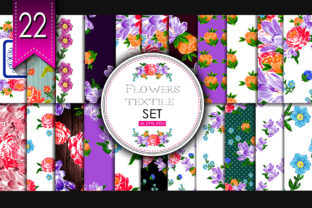
If you've ever spent hours tracing a scanned floral motif, adjusting resolution for print, or manually separating layers in Photoshop just to recolor a single petal—you’ll recognize the quiet relief that comes with a thoughtfully built Textile Flowers Set. This isn’t just another clipart pack. It’s a practical toolkit: 22 hand-crafted, scalable vector flowers delivered as Illustrator EPS 10 files and AI files—and mirrored in high-fidelity PSD format, each element on its own RGB layer, at 300 dpi. No guesswork. No pixelation. No layer-mashing.
Where These Flowers Actually Get Used (Beyond “Just Decoration”)
Designers don’t reach for floral assets because they’re pretty—they reach for them because a client needs a fabric repeat for a summer dress line, a boutique wants custom wrapping paper, or a craft studio is launching a limited-edition embroidery kit. The Textile Flowers Set fits seamlessly into those moments.
- Fashion & Textile Designers: Build seamless repeats in Illustrator using the EPS files—scale them to any size without losing edge sharpness, rotate stems for organic flow, or recolor entire blooms with global swatches. One designer used the peony and ranunculus vectors to develop three coordinated cotton poplin prints for a sustainable swimwear brand—all within a single afternoon.
- Packaging & Stationery Creators: The PSD files shine here. Because each petal, leaf, and stem lives on its own layer, you can selectively adjust opacity, add subtle drop shadows, or apply duotone overlays directly in Photoshop—ideal for luxury soap labels, wedding invites, or artisan tea box wraps. No flattening. No regrets.
- Digital Illustrators & Surface Pattern Artists: Mix and match elements across formats. Drop an EPS flower into Procreate via vector import (with compatible apps), then sketch over it with texture brushes—or paste a PSD bloom into a larger collage and use blending modes to integrate it with watercolor backgrounds.
- Small-Batch Makers & Etsy Sellers: Time is non-renewable. If you’re screen-printing tote bags or heat-pressing floral motifs onto linen napkins, having clean, ready-to-cut vectors means faster mockups, consistent color separation, and fewer last-minute file fixes before sending to your printer.
What Makes This Set Feel Like a Collaborator—Not Just a Download
It’s not about quantity—it’s about intentionality. Each of the 22 flowers was drawn with textile applications in mind: balanced negative space for dye penetration, simplified veins that won’t vanish at small scales, and petal counts that read clearly even when shrunk to 1.5 cm in a fabric repeat tile. You’ll notice stems curve naturally—not rigidly—so they drape convincingly across curved surfaces like ceramic mugs or curved phone cases.
The dual-format delivery solves real friction points. Need to tweak color harmony in RGB for web previews? Use the PSDs. Prepping for CMYK textile printing? Switch to the EPS files—no rasterization, no color shifts. And because all Illustrator files are saved in version 10 (not the latest), they open reliably in older Creative Suite installations—something freelancers supporting legacy studio setups deeply appreciate.
Who Might Pause Before Using It (and What to Consider)
This set excels when you need clarity, control, and consistency—but it’s worth pausing if your project leans heavily into raw, gestural, or highly stylized illustration. These are refined botanical interpretations—not abstract ink splatters or surrealist hybrids. They’re realistic enough to feel grounded, but stylized enough to avoid photographic stiffness.
Also consider scale context. While the vectors scale infinitely, the original PSD compositions were built around standard print-ready dimensions (roughly 3,000 × 3,000 px). If you’re designing for massive murals or architectural-scale wallpaper, you may want to reinforce key outlines or add slight stroke weight in Illustrator—just a minor polish, not a rebuild.
And while the RGB PSD layers give tremendous flexibility, they’re not layered by *color*—they’re layered by *element*. So if you’re planning to output spot-color separations for screen printing, you’ll still need to group layers by ink channel yourself. It’s a quick step, but one worth noting upfront.
Unexpected Ways People Are Putting These Flowers to Work
One interior designer used the magnolia and camellia vectors to create custom wall decals for a wellness clinic—scaling them to 48" tall, then converting to vinyl cut paths with zero distortion. A children’s book illustrator imported the daisy EPS into Affinity Designer, broke it into editable nodes, and gently exaggerated the center to match her character-driven style—keeping the base structure intact but making it unmistakably hers.
A university textile lab uses the set as a teaching anchor: students study the vector construction to understand how curves translate to woven jacquard looms, then experiment with rearranging petals in the PSDs to simulate different dye resist techniques digitally before touching physical fabric.
Even educators find value—not as clipart, but as visual vocabulary. A botany teacher printed the high-res JPGs (included at 300 dpi) as tactile flashcards, laminated them, and used them alongside real pressed flowers to teach symmetry, inflorescence types, and petal arrangement patterns.
Why Format Choice Matters More Than You Think
EPS 10 + AI gives you backward compatibility and full editability—no locked layers, no embedded rasters masquerading as vectors. You can ungroup, re-path, or isolate nodes without hunting for hidden clipping masks. That’s critical when adapting motifs for laser cutting templates or CNC engraving guides.
The PSD files aren’t flattened JPEGs dressed up as “layers.” They’re truly separated: stamen on Layer 1, outer petals on Layer 2, calyx on Layer 3, leaves on Layer 4—each named, grouped logically, and non-destructively editable. You can mute the stem, boost contrast on just the pistil, or add a noise overlay to only the sepals. That level of surgical control saves hours when refining for specific substrates—like ensuring delicate fern fronds stay legible on unbleached canvas.
And yes—the JPGs at 300 dpi are included for good reason. Not as placeholders, but as reliable, embeddable assets for client presentations, mood boards, or CMS uploads where vector support is spotty. They render crisply in InDesign layouts and load predictably in web-based pitch decks.
Real Talk: When This Set Fits—and When It Doesn’t
It fits when your priority is getting work done well, without reinventing the wheel. When you need trustworthy, production-ready florals that behave themselves across tools and outputs. When “I’ll just draw one quickly” has cost you two hours before—and you’d rather invest that time in concept development or client feedback.
It doesn’t fit if you’re building a signature artistic language from scratch and need every curve to be uniquely yours. Or if your workflow relies entirely on browser-based tools with no vector import capability. But for Adobe users, Affinity adopters, and anyone who values clean, adaptable, textile-aware botanical assets—it removes friction so you can focus on what matters: the idea, the client, the craft.