I Love Reading Clip Art Graphics, Patterns
For creators who design for children—whether in education, publishing, home goods, or small-batch product development—finding cohesive, high-quality visual assets that communicate joy, curiosity, and literacy is rarely simple. I Love Reading Clip Art Graphics, Patterns fills that gap with purpose-built, production-ready files designed not just to look charming, but to integrate cleanly into real-world creative and business workflows.
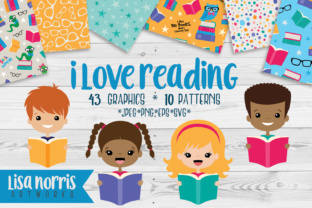
This collection isn’t a grab bag of isolated illustrations. It’s a coordinated system: 43 distinct graphics—including cheerful kids, expressive bookworms, open books, reading nooks, and whimsical literary motifs—plus 10 seamless patterns and two bonus border designs. Every file is delivered in multiple formats and resolutions, supporting both digital and print production without rework or compromise.
How These Assets Fit Into Your Creative Process
Most design projects follow an implicit sequence: planning → asset sourcing → composition → refinement → output. Where many clip art sets break down is at the handoff between sourcing and composition—low-res JPEGs, inconsistent line weights, missing transparency, or incompatible vector structures slow everything down. I Love Reading Clip Art Graphics, Patterns anticipates those friction points.
Before you open your design software, you already know the files will work. The 6×6 inch JPEGs and PNGs are sized for immediate use in Canva, Cricut Design Space, or Adobe Express. The PNGs include alpha channels, so dropping a smiling child holding a stack of books onto a custom tote bag mockup takes seconds—not minutes spent erasing backgrounds. The EPS and SVG files retain layered, editable paths, meaning you can adjust stroke weight, recolor individual elements, or isolate parts of a grouped illustration without breaking the design.
During layout, the seamless patterns shift from decorative flourish to functional tool. Each of the 10 patterns (and the two bonus borders) is provided as a 4000×4000 px JPEG, an EPS, and a dedicated vector file. That means you can tile a “book spine” pattern across a full-width classroom bulletin board background in Illustrator—or apply it as a subtle watermark overlay in a printable reading log PDF. No scaling artifacts. No pixelation when enlarged for fabric printing. No need to rebuild repeats from scratch.
Practical Integration Across Platforms and Outputs
Compatibility isn’t theoretical—it’s about whether the file opens in your workflow without error or delay. This collection supports broad platform interoperability by design:
- For educators: Use the SVG files directly in Google Slides or PowerPoint to build interactive storytime slides. Resize without quality loss, then export as PDF handouts with crisp text and imagery.
- For crafters and makers: Load SVGs into Cricut Design Space or Silhouette Studio for precise cutting on vinyl, iron-on, or cardstock. Grouped SVGs let you select just the “reading owl” or entire “library scene” depending on project scale.
- For small business owners: Apply seamless patterns to Spoonflower fabric uploads or Printful product templates. The 4000×4000 px resolution meets standard textile print requirements; the vector versions allow color-way variations without resampling.
- For publishers and content creators: Embed PNGs in blog posts or newsletters with consistent 300 dpi clarity. Use EPS files in InDesign layouts where vector fidelity matters—especially for printed reading logs, classroom posters, or curriculum workbooks.
The vector files also support long-term flexibility. If your brand palette shifts next year, you won’t need to relicense new art—you’ll simply open the EPS or SVG and update fill colors globally. That’s efficiency built into the asset structure, not added later through extra steps.
Organization and Usability Built for Real Workflows
Clarity in file naming and grouping reduces cognitive load during active projects. The 43 graphics are delivered in three logical groupings: JPEG, PNG, and vector formats—but within each, files are named descriptively (girl_reading_blue_book.png, bookworm_cat_vector.eps). There’s no deciphering cryptic codes or cross-referencing spreadsheets.
The 34 SVG files aren’t identical duplicates—they’re organized by use case. Some contain single elements for maximum modularity; others combine related items (e.g., “reading corner scene”) for faster scene-building. That saves time when you need either precision or speed, depending on the task.
Similarly, the 10 seamless patterns each have their own vector file—meaning you can edit repeat units individually if needed (say, adjusting spacing for a specific fabric width), rather than wrestling with a single monolithic EPS containing all patterns.
Quality Control and Consistency You Can Rely On
Every graphic shares the same stylistic language: friendly proportions, clean outlines, balanced negative space, and warm, accessible color palettes. That consistency eliminates visual whiplash when assembling multi-element projects—like a series of classroom posters or a themed stationery line.
The 300 dpi resolution across JPEG and PNG files ensures sharpness for both screen and print outputs up to 6×6 inches. For larger applications—think wall decals or fabric yardage—the vector files preserve scalability without degradation. There’s no guesswork about which format to choose for a given output; the collection provides the right tool for each stage.
And because all files are pre-tested for common compatibility issues (transparency handling in older software, embedded fonts in EPS, SVG path integrity), you avoid the last-minute surprises that derail deadlines—like a vector failing to render in a client’s outdated version of CorelDRAW.
Workflow Examples: From Concept to Delivery
Example 1: Creating a Custom Reading Challenge Printable
An elementary teacher plans a month-long “Read 20 Books” challenge. She starts by selecting three SVG graphics—a star, a stack of books, and a smiling child—and layers them in Canva. She uses the seamless “open book” pattern as a subtle background texture behind the title bar. All elements resize cleanly. She exports as a print-ready PDF, then shares the editable Canva link with colleagues for localized adaptations.
Example 2: Launching a Small-Batch Fabric Line
A textile designer licenses the collection to develop a nursery-themed fabric range. She imports the “bookworm hedgehog” SVG into Affinity Designer, adjusts stroke weight for screen printing clarity, then arranges it into a half-drop repeat using the included vector pattern file as a base. The final swatch file meets Spoonflower’s technical specs without additional prep.
Example 3: Building Branded Classroom Resources
A curriculum developer creates a set of phonics flashcards. She uses the PNGs for quick drag-and-drop into her template, then swaps in the EPS versions for the cover poster—ensuring vector sharpness at large display sizes. The unified style ties the entire resource suite together visually, reinforcing learning continuity for students.
Making It Last: Long-Term Value Beyond the First Project
Assets like I Love Reading Clip Art Graphics, Patterns pay dividends over time—not just per project, but per decision point. When you don’t have to search, trace, or redraw, you reclaim hours across quarters. When color edits, sizing, and format conversions happen in seconds instead of hours, your capacity for iteration increases. When consistency is baked in—not patched on—you spend less time reviewing and more time shipping.
That reliability compounds: the same files used for a school newsletter one month can become the basis for a parent workshop handout the next, then a laminated classroom poster the following semester—all without licensing overhead or quality trade-offs.
It’s not about owning more assets. It’s about owning the right ones—structured, tested, and ready to move with you from idea to execution, across tools, timelines, and outcomes.