Travel the World Clip Art Graphics, Patterns
If you’ve ever stared at a blank fabric swatch, a half-finished scrapbook page, or a classroom bulletin board wondering how to bring energy and global charm to your project—Travel the World Clip Art Graphics, Patterns is the kind of resource that quietly solves more than you’d expect. It’s not just another clip art pack. It’s a thoughtfully built toolkit for makers, educators, small business owners, and DIY enthusiasts who want authentic, ready-to-use travel-themed visuals—without wrestling with licensing headaches or pixelated downloads.
What You’re Actually Getting (and Why It Matters)
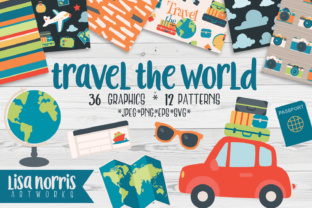
This collection includes 36 original travel-themed graphics—think vintage suitcases, compass roses, hot air balloons, passports stamped with whimsical countries, retro airplanes, globes, postcards, and tiny landmarks like Eiffel Towers and tuk-tuks—all designed with clean lines and cheerful, inclusive energy. Each graphic comes in multiple formats: 6×6 inch JPEG and PNG files at 300 dpi (ideal for high-quality printing), SVG files (perfect for Cricut and Silhouette users), an EPS vector file containing all 36 as one editable group, and a single 10-vector EPS file for professional design workflows.
Then there are the 12 seamless patterns, each sized at 4000×4000 px JPEG and delivered as individual EPS and SVG files. These aren’t filler repeats—they’re cleverly composed motifs: “passport stamps on kraft paper,” “tiny planes flying across sky-blue grids,” “compass points layered over watercolor maps,” and “luggage tags arranged like Moroccan tile.” Plus, two bonus border patterns add polish to banners, placemats, or printable worksheets.
Where This Collection Fits Into Real Life
You don’t need to be a graphic designer to benefit from Travel the World Clip Art Graphics, Patterns. You just need a project where place, movement, curiosity—or childhood wonder—matters.
- Fabric designers and indie sewists use the seamless patterns to create custom quilting cottons, tote bags, or nursery curtains. One customer printed the “stamped passport” pattern onto organic cotton and turned it into matching backpacks for her travel-themed summer camp program—kids loved spotting their own “visas” on the fabric.
- Teachers and homeschoolers lean on the SVGs and PNGs for interactive learning tools: cut-out geography games, country-report posters, passport-style reading logs, or themed reward charts. The 300 dpi resolution means crisp prints—even when enlarged on classroom displays.
- Small-batch stationery makers layer the vector graphics into greeting cards, travel journals, and printable planners. Because all elements are scalable and fully editable, swapping colors to match a brand palette or adjusting spacing for a specific layout takes seconds—not hours.
- Scrapbookers and paper crafters appreciate the consistent 6×6 inch sizing. It fits standard photo mats and aligns neatly across double-page spreads. The PNG files include transparent backgrounds, so no awkward white boxes around a vintage suitcase or a paper plane mid-flight.
- Home decor creators (think Etsy sellers or boutique interior stylists) use the patterns for digital wallpaper mockups, framed art prints, or stencils for hand-painted furniture. The vector files allow resizing without loss—even for large-scale wall decals up to 24×36 inches.
Who Benefits Most—and How Their Needs Differ
A freelance educator designing a world cultures unit needs clarity and cultural neutrality—so she’ll likely avoid overly stylized landmarks and instead choose the abstract compass rose or neutral luggage icons. A children’s book illustrator, meanwhile, might pull the playful tuk-tuk or smiling globe to build visual continuity across characters and scenes. And a print-on-demand shop owner will prioritize the seamless patterns’ scalability and color flexibility—knowing they’ll render cleanly across mugs, notebooks, and phone cases in varying sizes.
The strength of this collection lies in its intentional versatility: no single image dominates the theme, and nothing feels dated or narrowly commercial. There are no stock-photo clichés—no overly posed models holding globes, no generic “dream vacation” tropes. Instead, it offers quiet, reusable moments of exploration: a folded map, a stack of postcards, a tiny hot air balloon trailing string. That subtlety makes it adaptable across age groups, markets, and mediums.
Things to Consider Before You Start Using It
First—check your software compatibility. While SVGs work natively in most cutting machines and modern browsers, older versions of Adobe Illustrator or CorelDRAW may require slight tweaks to open the EPS files. If you're planning large-format printing (like banners or murals), test one pattern tile at full size first—the 4000×4000 px resolution holds up beautifully, but screen previews can sometimes misrepresent subtle texture details.
Second—think about color context. The graphics are delivered in rich, saturated tones, but they’re fully editable in vector format. That means you can easily shift a red suitcase to navy for a school branding project or mute the background of a pattern for a minimalist nursery. If you’re using the JPEGs for physical products, remember that monitor colors vary—always soft-proof against your printer’s profile if color accuracy is critical.
Third—consider scale intention. The 6×6 inch base size is ideal for crafts and small prints, but if you’re designing for apparel (like a T-shirt chest logo), you may want to simplify or recombine elements—say, pairing the compass rose with a single word (“Wander”) rather than stacking five icons. Less clutter often reads louder.
What It Does Well (and Where It’s Honest About Limits)
Travel the World Clip Art Graphics, Patterns excels at delivering immediate, joyful utility. It saves time—not just because files are pre-sized and multi-format, but because the aesthetic cohesion means you won’t waste hours mixing mismatched styles. You also get commercial-use rights, which matters whether you’re selling handmade goods or licensing digital products.
That said, it’s not meant to replace custom illustration. If your brand requires highly specific cultural references (e.g., accurate regional dress, architectural details of a particular city), these stylized icons won’t substitute for research-backed artwork. Likewise, while the collection includes diverse symbols—tuk-tuks, rickshaws, bamboo bridges—it doesn’t attempt exhaustive geographic representation. Its power is in suggestion, not simulation.
And while the 12 seamless patterns cover strong thematic ground, they’re not infinite. You won’t find ultra-minimalist line-only options or photorealistic textures here—this is a joyful, accessible, hands-on collection, not a high-end design library. That’s by design. It meets the sweet spot where practicality, personality, and ease intersect.
Real Projects, Real Results
A Montessori teacher used the “postcard pattern” to create laminated continent sorting cards—each card featured a different corner of the pattern, helping kids associate visual rhythm with geographic regions. A fabric boutique owner printed the “airplane grid” pattern on linen and sold it as limited-run yardage for travel-themed baby showers—every bolt sold out in under 48 hours. A teen created a “My Dream Trip” vision board for a school presentation using the SVGs in Canva, then laser-cut the same icons from wood for a 3D display.
None of those uses were spelled out in the product description—but they happened because the files were flexible, respectful of real creative constraints, and rooted in shared human experiences: packing a bag, unfolding a map, imagining somewhere new.